October
28,
2026



In 2026, writing a high-performing blog post is no longer about « placing keywords », but about demonstrating genuine expertise and structuring information for two readers at once: the human and the machine.
The method comes down to five steps: choose a keyword aligned with search intent, structure the article with a direct answer up front, write content that covers the topic in depth and shows real experience, optimize it for classic SEO and AI engines (GEO), then update it regularly. The guiding principle stays Google's: write first and foremost to help a real person.
Google's whole doctrine fits in one question: « Who are you creating this content for? » If the answer is « first and foremost to help a real reader », you are aligned with what search systems reward. If it is « first and foremost to capture traffic », you will sooner or later be downranked.
This « people-first » principle drives everything else. A useful article fully answers the question asked, without filler, and brings something the already-ranked pages lack.


The 2026 holiday season is approaching, and while consumers are still willing to spend, they are becoming much more selective about where that money goes.
Shoppers are researching earlier, comparing more options, looking harder for value and increasingly using AI to help make decisions. At the same time, brands are competing for attention during a season where consumer budgets remain under pressure.
For businesses, the opportunity is still significant. Canadian retail sales excluding automotive and gas grew around 4% in Q4 2025, despite expectations for relatively flat holiday spending.
The lesson? Cautious consumers are not necessarily inactive consumers.
Winning Holiday 2026 will come down to being visible early, communicating your value clearly and staying flexible enough to react as shopping behaviour changes.


In digital marketing, every dollar spent leaves a trail. Impressions show where a brand appears. Clicks reveal where interest begins. Orders confirm where demand becomes real. Yet even with this level of visibility, many businesses still struggle with a key question in paid media: where is our budget actually performing best?

In today’s digital landscape, collecting data has never been faster or easier. Every transaction, click, and product interaction feeds into a growing network of information that businesses are continuously capturing. Yet for many, this wealth of data remains untapped, sitting quietly in databases with the potential to transform how decisions are made.

The Shopify Winter Edition 2026 has arrived and this release is materially different from prior Editions. Rather than shipping isolated features, Shopify is clearly advancing a broader ambition: evolving from a commerce platform into a connected commerce network powered by native AI, distribution, and developer acceleration.
For agencies such as Webtmize operating at the intersection of ecommerce strategy, marketing execution, and technical delivery, this Edition introduces meaningful opportunities and new expectations from merchants across DTC, B2B, and enterprise segments.

Black Friday is no longer just a single shopping day—it’s a high-stakes, highly competitive period where e-commerce brands must use every advantage available to maximize sales. With Artificial Intelligence (AI) and Generative Engine Optimization (GEO) transforming the digital marketing landscape, agencies and e-commerce teams need to rethink how they approach PPC, SEO, and customer engagement this holiday season.

When the doors opened at BrightonSEO 2025 in San Diego, the energy in the room was undeniable. For years, the industry has been flooded with the same dramatic headline: “SEO is dead.”
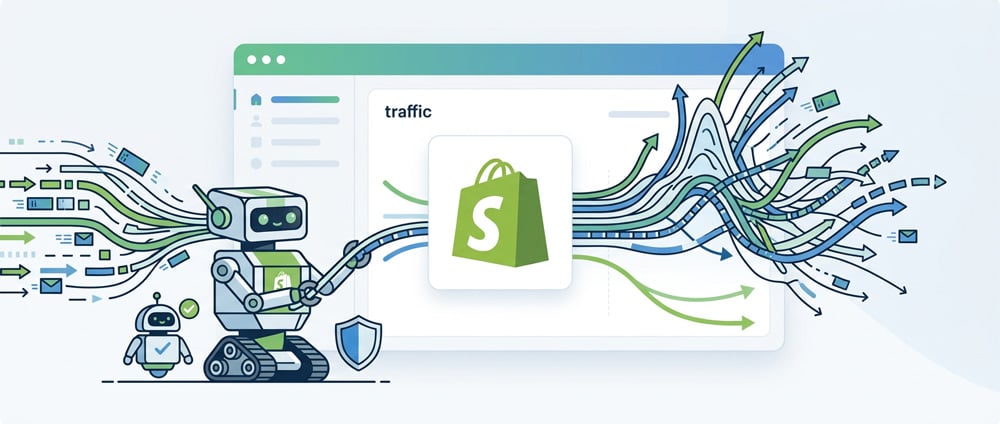
Most Shopify stores get more bot traffic than their owners realize. In fact, in 2026, we now have confirmation that a majority of web traffic is from bots. Some of it is...
In 2026, writing a high-performing blog post is no longer about « placing keywords », but about demonstrating genuine expertise and structuring information for two readers at once: the human and the machine.
The method comes down to five steps: choose a keyword aligned with search intent, structure the article with a direct answer up front, write content that covers the topic in depth and shows real experience, optimize it for classic SEO and AI engines (GEO), then update it regularly. The guiding principle stays Google's: write first and foremost to help a real person.
Google's whole doctrine fits in one question: « Who are you creating this content for? » If the answer is « first and foremost to help a real reader », you are aligned with what search systems reward. If it is « first and foremost to capture traffic », you will sooner or later be downranked.
This « people-first » principle drives everything else. A useful article fully answers the question asked, without filler, and brings something the already-ranked pages lack.
At BrightonSEO 2026, one theme came up again and again, in different words from different speakers: the old vocabulary of rankings and traffic is giving way to a new one...
The 2026 holiday season is approaching, and while consumers are still willing to spend, they are becoming much more selective about where that money goes.
Shoppers are researching earlier, comparing more options, looking harder for value and increasingly using AI to help make decisions. At the same time, brands are competing for attention during a season where consumer budgets remain under pressure.
For businesses, the opportunity is still significant. Canadian retail sales excluding automotive and gas grew around 4% in Q4 2025, despite expectations for relatively flat holiday spending.
The lesson? Cautious consumers are not necessarily inactive consumers.
Winning Holiday 2026 will come down to being visible early, communicating your value clearly and staying flexible enough to react as shopping behaviour changes.
Organic search is not just one channel among many for an e-commerce business: it is the channel. Around 40% of e-commerce site traffic comes from organic search, and it...
In digital marketing, every dollar spent leaves a trail. Impressions show where a brand appears. Clicks reveal where interest begins. Orders confirm where demand becomes real. Yet even with this level of visibility, many businesses still struggle with a key question in paid media: where is our budget actually performing best?
In today’s digital landscape, collecting data has never been faster or easier. Every transaction, click, and product interaction feeds into a growing network of information that businesses are continuously capturing. Yet for many, this wealth of data remains untapped, sitting quietly in databases with the potential to transform how decisions are made.
The Shopify Winter Edition 2026 has arrived and this release is materially different from prior Editions. Rather than shipping isolated features, Shopify is clearly advancing a broader ambition: evolving from a commerce platform into a connected commerce network powered by native AI, distribution, and developer acceleration.
For agencies such as Webtmize operating at the intersection of ecommerce strategy, marketing execution, and technical delivery, this Edition introduces meaningful opportunities and new expectations from merchants across DTC, B2B, and enterprise segments.
Black Friday is no longer just a single shopping day—it’s a high-stakes, highly competitive period where e-commerce brands must use every advantage available to maximize sales. With Artificial Intelligence (AI) and Generative Engine Optimization (GEO) transforming the digital marketing landscape, agencies and e-commerce teams need to rethink how they approach PPC, SEO, and customer engagement this holiday season.
When the doors opened at BrightonSEO 2025 in San Diego, the energy in the room was undeniable. For years, the industry has been flooded with the same dramatic headline: “SEO is dead.”